Industries
Get direct access to our extensive portfolio of optical products and specialist technical expertise.

Choosing among the 7 Best Laser Lighting Factory China Suppliers requires more than comparing prices. It requires evidence.
The global lighting industry is changing quickly. The International Energy Agency reports that LED products now dominate new lighting sales, driven by lower energy use and longer service life. Meanwhile, Grand View Research identifies laser technology as a growing solution for automotive, entertainment, projection, and industrial applications. These trends create opportunities for buyers, but they also create confusion. Not every supplier using “laser” offers the same optical performance, safety controls, or manufacturing depth.
This guide examines each Laser Lighting Factory China through practical indicators. These include product engineering, beam quality, thermal management, certification support, production capacity, and export experience. A reliable factory should explain its laser class, wavelength, power stability, housing materials, and expected lifetime. Clear test records matter. So do traceable samples.
The U.S. Department of Energy’s solid-state lighting research highlights the importance of thermal design, efficiency, and dependable performance. Those principles apply here. A bright product can still fail in a hot venue, dusty workshop, or continuous-use installation.
No ranking is flawless.
Supplier websites often show polished images, not factory limitations. That is why this selection considers available technical evidence, communication quality, sample results, and after-sales responsibility. Buyers should still request current certifications and independent testing. China offers strong manufacturing capability, but careful verification remains essential.
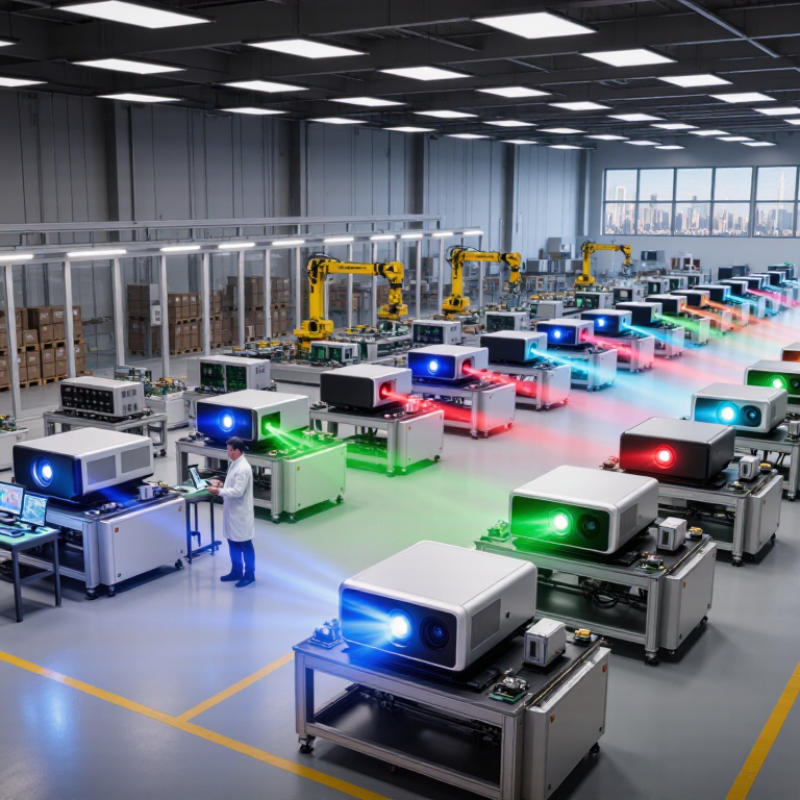
A reliable laser lighting factory in China should prove performance, not merely promise it. The International Energy Agency reports that lighting uses about 15% of global electricity demand. Efficient optical design therefore matters beyond marketing language. Ask for measured luminous output, beam angle, power consumption, thermal rise, and lifetime test conditions.
Safety controls reveal manufacturing maturity. IEC 60825-1 requires laser products to follow classification, labeling, and accessible-emission limits. A dependable factory should provide test records, protective housings, interlocks, and clear user instructions. Request product samples from different batches. Check solder joints, cable strain relief, cooling fans, and enclosure sealing. Small details often expose weak process control.
Quality systems also need traceability. ISO 9001 procedures should connect incoming components with assembly records, calibration certificates, and final inspection results. An independent laboratory report is stronger than an internal spreadsheet. The factory should explain how it handles failed units, corrective actions, and design changes. Ask for aging tests under realistic heat and voltage conditions. A 24-hour demonstration is useful, but it is not a lifetime guarantee. No audit is perfect. I have seen polished samples hide inconsistent production, so supplier verification should continue after the first shipment. According to the IEA’s energy-efficiency analysis, better-performing lighting can reduce operating demand, but only when rated performance matches field performance.
| No. | Supplier Evaluation Dimension | Reliable Factory Benchmark | Recommended Verification Evidence | Why It Matters |
|---|---|---|---|---|
| 1 | Laser safety and product classification | IEC 60825-1 alignment | Request the laser product classification, wavelength and output-power information, user instructions, warning labels, and applicable test reports. IEC 60825-1 is the international safety standard commonly used for laser products. | Incorrect classification or missing warnings can create eye-safety risks, import delays, and compliance problems in the destination market. |
| 2 | Quality-management system | Documented quality controls | Check whether the factory has a current ISO 9001 certificate issued by an accredited certification body, documented incoming inspection, in-process inspection, final inspection, and corrective-action records. | A formal quality system improves batch consistency and makes recurring defects easier to trace and correct. |
| 3 | Optical and electrical performance consistency | Measured, not only promised | Ask for production test records covering output power, beam pattern, scanning angle, modulation response, operating temperature, input voltage, and unit-to-unit variation. | Unverified performance may lead to unstable projections, visible color differences, excessive heat, or premature product failure. |
| 4 | Environmental protection and durability | Application-matched IP rating | Confirm the declared IP rating and request the relevant test report. For outdoor installations, also check corrosion protection, cooling design, cable sealing, temperature range, and vibration or transport testing. | A product designed only for indoor use may suffer water ingress, corrosion, overheating, or electrical faults outdoors. |
| 5 | Regulatory and material compliance | Market-specific documentation | Verify applicable EMC, electrical-safety, RoHS, REACH, or other destination-market requirements. Request test reports that identify the exact model, revision, and tested configuration. | Generic or mismatched certificates may not support customs clearance, marketplace listing, or legal sale in the target country. |
| 6 | Manufacturing capacity and supply continuity | Capacity supported by records | Evaluate production equipment, assembly and aging-test areas, staffing, normal lead time, minimum order quantity, monthly capacity, component sourcing, and a documented plan for handling shortages. | Insufficient capacity or single-source components can cause missed launch dates, inconsistent components, and unexpected price changes. |
| 7 | After-sales support and customization | Written service terms | Confirm warranty duration, spare-parts policy, repair or replacement procedure, response time, firmware-support process, packaging options, OEM/ODM capability, and pre-shipment sample approval. | Clear service terms reduce downtime and provide practical protection when a batch contains defects or requires project-specific modifications. |
Note: These criteria are intended for comparing anonymous laser-lighting factories. Certificates, test reports, and performance claims should be verified for the exact product model and destination market before purchase.