Industries
Get direct access to our extensive portfolio of optical products and specialist technical expertise.

As cities grow denser, parking areas must protect people, storefronts, and building entrances without making access feel hostile. UN DESA’s World Urbanization Prospects 2018 projects that 68% of the world’s population will live in urban areas by 2050. That shift puts practical pressure on site planning. Steel Parking Bollards can help define vehicle boundaries and guard vulnerable edges, but the right choice depends on placement, anchoring, visibility, and expected impact.
The material matters, too. World Steel Association’s World Steel in Figures 2024 reports global crude steel production of 1,892.2 million tonnes in 2023. This figure shows steel’s enormous industrial scale; it does not prove that any bollard is safe or suitable. Buyers should ask manufacturers for clear specifications, finish options, installation guidance, and relevant test documentation. A sturdy-looking post is not enough.
Urban designer Jan Gehl offers a useful planning principle: “First life, then spaces, then buildings—the other way around never works.” It is not a bollard specification, but it reminds buyers to start with people’s movement and needs. For projects sourcing from China, compare suppliers on fabrication quality, consistency, communication, and evidence—not price alone. Check the base plate, welds, coating, and fixing method against the site conditions. Small details matter. Still, even careful selection cannot replace competent installation or regular inspection. This guide introduces what to assess when choosing a China-based Steel Parking Bollards manufacturer for sale, while recognizing that product claims deserve verification.
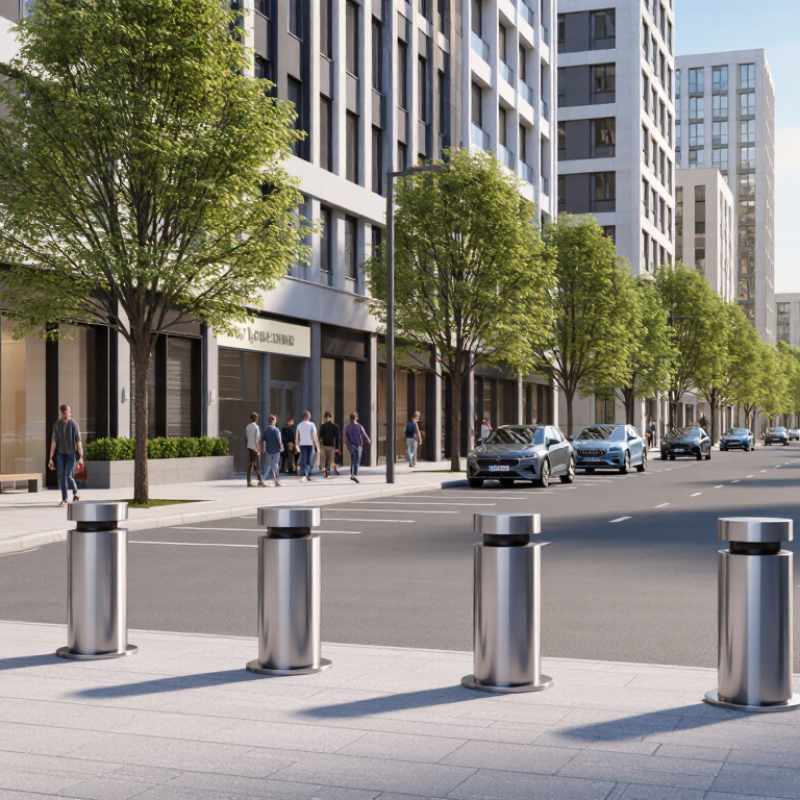
Steel parking bollards are sturdy vertical posts that help define parking spaces, protect walkways, and discourage vehicles from entering restricted areas. They are commonly made from steel pipe and may be surface-mounted with a base plate or embedded in concrete. Their visible height, spacing, and finish help drivers notice boundaries, especially near storefronts, loading zones, and pedestrian paths.
Some bollards provide visual guidance; others are designed to resist vehicle impact. The difference is critical. A plain steel post is not automatically crash-rated. Its performance depends on the steel, wall thickness, foundation, installation depth, and tested impact rating. NHTSA’s Traffic Safety Facts 2022 reported 7,522 pedestrian deaths in U.S. traffic crashes. That figure is not specific to parking lots, but it highlights why separating people from moving vehicles matters.
For a real site, check the vehicle risks and ground conditions before choosing a bollard. A shallow base plate on weak paving may not perform like a deeply embedded post in reinforced concrete. Not always obvious. Reflective bands can improve visibility at night, while spacing should still allow accessible routes and practical vehicle movement. The overlooked detail is often the foundation, not the steel finish. A qualified installer can verify dimensions and anchoring against the site plan and the intended level of protection.
| Data Dimension | Typical Information | How It Works or Why It Matters |
|---|---|---|
| Definition | A steel parking bollard is a short, sturdy post installed to define vehicle boundaries or help protect people, buildings, and equipment. | It creates a visible physical barrier that can discourage or restrict vehicle access, depending on its design and installation. |
| Common Materials | Carbon steel and stainless steel are commonly used. Outdoor carbon-steel units are often galvanized, painted, or powder-coated for corrosion protection. | Material and finish affect strength, appearance, maintenance needs, and resistance to weather or corrosive environments. |
| Typical Above-Ground Height | Approximately 600–1,200 mm (24–48 in), depending on the intended use and site layout. | Height influences visibility and how effectively the post defines a boundary. Local accessibility, traffic, and building requirements should also be considered. |
| Typical Outside Diameter | Approximately 100–200 mm (4–8 in) for many general-purpose steel bollards. | A larger diameter may provide a more substantial barrier, but diameter alone does not determine impact performance. |
| Fixed, In-Ground Bollard | Secured in a foundation or embedded below ground; the visible post remains in place. | Suitable for permanent separation or access control where the post does not need to be moved. Foundation design and ground conditions are important. |
| Removable Bollard | Fits into a ground sleeve or socket and can be lifted out when access is required. | Allows occasional vehicle access through a protected area. A locking or securing method helps keep the bollard in position when installed. |
| Retractable Bollard | Moves up and down within a below-ground housing; operation may be manual or powered. | Provides a clear route when lowered and a visible barrier when raised. Drainage, maintenance access, and power requirements may apply. |
| Surface-Mounted Bollard | Attached to a concrete surface with suitable anchors and a base plate. | Can be used where excavation is impractical. Its performance depends on the slab, anchor type, edge distance, and installation quality. |
| How Bollards Work | Posts establish a physical boundary, channel vehicles, protect specific areas, or control entry. | Spacing and placement should prevent unwanted vehicle passage while maintaining safe pedestrian routes and required emergency access. |
| Common Applications | Parking areas, building entrances, pedestrian zones, loading areas, storefronts, and equipment protection. | The bollard type and layout should match the expected vehicle movement, site conditions, and level of protection needed. |
| Impact-Rating Consideration | Not every steel bollard is crash-rated or designed to stop a moving vehicle. | Where vehicle-impact resistance is required, check independent test documentation for the complete system, including the bollard, foundation, and installation method. |
| Installation Considerations | Review underground utilities, soil and slab conditions, drainage, post spacing, visibility, and local codes before installation. | Correct installation helps the bollard perform as intended and reduces the risk of water accumulation, loosening, or interference with access routes. |
| Maintenance | Inspect the post, coating, base, anchors, locks, and moving parts periodically. | Repair damaged finishes and address corrosion or loose fixings promptly. Retractable and removable units may require additional cleaning and functional checks. |
Note: Dimensions shown are general examples, not universal specifications. Confirm product drawings, installation requirements, and applicable local standards for each project.