How to Choose a Hybrid Solar Charge Controller
Choosing a Hybrid Solar Charge Controller is not just a matter of matching a price tag to a solar array. The controller must suit your battery bank, panel voltage, charging method, and expected daily energy use. A mismatch can limit charging or expose batteries to settings they cannot safely use. Start with the basics.
Check whether your system uses a 12-, 24-, or 48-volt battery bank, then verify the controller supports that voltage. Compare the solar array’s open-circuit voltage and maximum current with the controller’s published limits. Cold mornings can raise panel voltage, so leave an appropriate safety margin rather than relying only on typical operating figures. For hybrid systems, clarify how solar charging interacts with grid or generator input, and whether the unit manages both sources or works alongside separate equipment.
Battery chemistry matters. Lead-acid and lithium batteries may require different charge profiles, and lithium models can have specific communication requirements. Read both the controller and battery manuals; product descriptions often leave out important compatibility details. Also consider the inverter, installation space, ventilation, and service access. Heat can reduce equipment performance, especially in a cramped enclosure. Small details count.
In this guide, we’ll examine controller types, electrical ratings, battery settings, and practical installation questions. We’ll also look at trade-offs that are easy to overlook, including monitoring features and room for future expansion. No single model fits every system. A careful comparison, based on verified specifications and your actual loads, is a better starting point than a confident guess. I would still double-check the final configuration with a qualified solar professional when system details are uncertain.
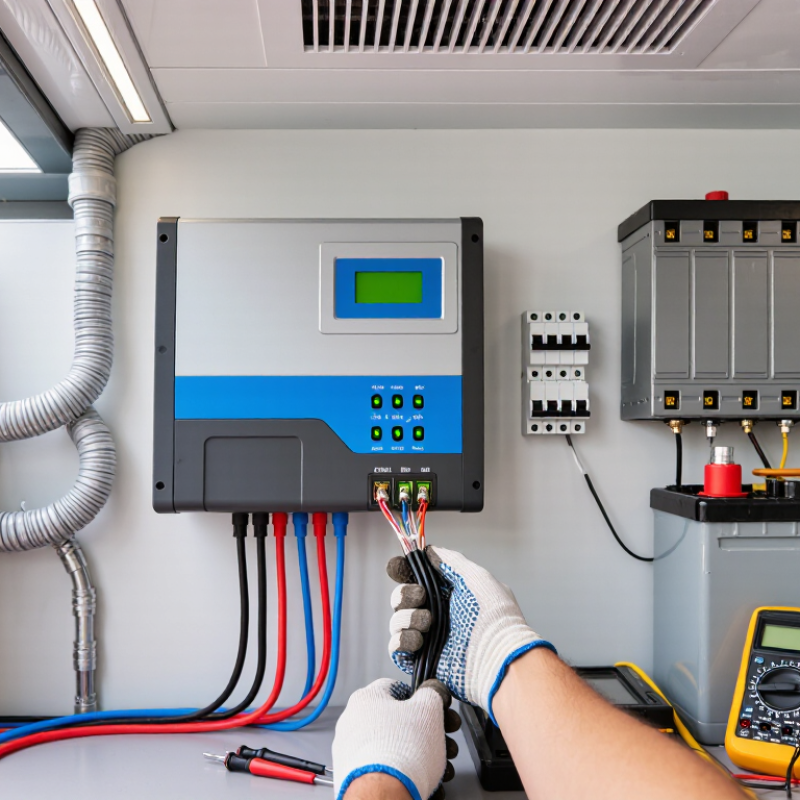
How a Hybrid Solar Charge Controller Works
How a Hybrid Solar Charge Controller Works
A hybrid solar charge controller coordinates energy from solar panels, a battery, and, in some systems, grid or generator power. Panel electricity enters as direct current. The controller tracks changing sunlight and adjusts the panels’ operating point to collect useful power. Clouds can change output within minutes.
It also regulates battery charging. During bulk charging, available solar power raises the battery’s charge. The controller may then reduce current during absorption and maintain a lower float level, depending on battery chemistry and settings. Not every model uses the same stages. Incorrect voltage limits can shorten battery life, so check the battery specifications rather than relying on a default.
When solar output dips, a hybrid system may draw from another configured source or limit connected loads. Exact behavior depends on the equipment and its settings. A display might show panel voltage, charge current, and battery state; compare those readings during clear midday conditions. That helps reveal obvious problems. Still, a single reading can mislead. Loose connections, heat, or shading may affect performance, and cable sizing matters too. The system can look simple on screen while hiding a less tidy installation.
How to Calculate Your System’s Voltage and Current Requirements
How to Choose a Hybrid Solar Charge Controller
How to Calculate Your System’s Voltage and Current Requirements
Start with the battery bank’s nominal voltage: commonly 12, 24, or 48 volts. The controller must support that voltage and the battery’s charging profile. Add the panel wattages to find total solar-array power. For a rough output-current estimate, divide array watts by battery charging voltage, then allow a safety margin within the controller’s rated limits.
For example, a 1,200-watt array charging a 24-volt battery bank may deliver about 42 amps at 28.8 volts. Actual output varies with sunlight, temperature, and system losses. Check the controller’s maximum output current, not just its advertised solar input wattage. A mismatch here can limit production or overload equipment.
Now check the panels’ voltage. Add their open-circuit voltage (Voc) in series, then account for the increase in cold weather using the panel’s temperature coefficient. The corrected voltage must stay below the controller’s maximum PV input voltage. Parallel strings increase current, so compare their combined short-circuit current (Isc) with the controller’s input-current limit. Check the labels. Hybrid units may also have separate limits for grid or generator charging, so verify those ratings and the battery maker’s charging specifications. Real-world wiring losses can complicate the neat arithmetic; measure carefully, and ask a qualified installer to review uncertain calculations.
How to Match the Controller to Your Battery Chemistry
Battery chemistry should determine the charging profile, not just a “12-volt” label. Lead-acid batteries use bulk, absorption, and float stages. Flooded models may also need equalization, while AGM batteries generally require it disabled unless their manual says otherwise. Small setting errors matter. Enable temperature sensing when the battery maker requires it, especially if the battery sits in a cold shed or a hot vehicle.
LiFePO4 batteries need a lithium profile matched to their voltage limits and battery-management system (BMS). Set absorption voltage and duration from the battery documentation; do not copy lead-acid values. Check whether the controller or BMS blocks charging below freezing.
NREL’s 2024 Annual Technology Baseline uses 85% round-trip efficiency as a modeled utility-scale battery-storage assumption. That is a system estimate, not a guarantee for a home battery or a controller setting.
Easy to miss. Before buying, compare supported chemistries, voltage ranges, temperature compensation, and BMS communication with the battery manual. I still verify settings after installation; menus can label similar functions differently.
How to Compare Charging Modes, Inputs, and Protection Features
A hybrid solar charge controller may accept power from solar panels and another source, such as an alternator or AC charger. The word “hybrid” is not used consistently, so check the wiring diagram rather than relying on the label. Confirm each input’s voltage and current limits, and whether sources can charge the battery at the same time. A shaded panel string and a running vehicle can behave very differently.
Compare charging modes against your battery’s requirements. MPPT can adjust panel voltage to improve energy harvest when panel voltage exceeds battery voltage; PWM controllers work differently and may suit simpler setups. Check for adjustable bulk, absorption, and float stages, plus a profile that matches your battery chemistry. Lithium batteries, for example, may need a low-temperature charging cutoff. Small details matter. A preset is convenient, but it may not match every battery model.
Protection features deserve equal attention. Look for safeguards against reverse polarity, overcurrent, overheating, and excessive input voltage. Check whether the controller limits charging when the battery is too cold, and whether it reports faults clearly. A screen showing battery temperature and charging current can help diagnose a weak connection before it becomes a bigger problem. Installation still matters: undersized cable can cause voltage drop, even with a capable controller. I would not choose by feature count alone; some safeguards sound reassuring but are useful only when their limits match the system.
How to Check Installation Needs and Future System Expansion
Before choosing a hybrid solar charge controller, map the installation rather than guessing from panel wattage. Record the battery voltage and chemistry, the solar array’s open-circuit voltage, and the expected charging current. Check whether the controller can accept every charging source your setup uses, such as solar and a backup generator. Hybrid units handle inputs differently.
Look at the physical space, too. A controller mounted in a hot utility closet may need more clearance and airflow than one in a shaded garage. Measure cable runs from the panels and battery; long runs can increase voltage drop, so wire size and protection devices matter. Keep terminals accessible for inspection. Small detail. It is easy to overlook.
Plan for changes you may actually make, such as adding two panels or a second battery bank. Compare the controller’s maximum PV voltage and current limits with the expanded array, not just today’s equipment. Also confirm that battery settings, charge profiles, and communication options will still suit the planned storage. Leave a sensible margin, but avoid paying for capacity you have no use for. I would verify the figures against equipment manuals, then have a qualified installer review the wiring layout and local requirements. Plans change; a neat diagram can still miss a real constraint.
