How to Choose Modern Lights for Your Home?

Choosing Modern Lights is not only about matching a fixture to a sofa or paint color. Light changes how a room feels, how clearly you see, and how much energy you use. Small details matter. A warm lamp beside an armchair can feel restful, while a bright ceiling fixture may make the same corner feel stark.

The U.S. Department of Energy’s LED lighting guidance says LED bulbs use at least 75% less energy and last up to 25 times longer than incandescent bulbs. Those figures make efficiency worth checking, but they do not tell you whether a light suits your room. Look at brightness, color temperature, dimming compatibility, and the fixture’s scale. A narrow hallway needs a different spread of light than a dining table. Not just style.

Lighting designer Ingo Maurer is often quoted as saying, “I am not interested in making light bulbs. I am interested in making light.” His words point to a useful distinction: a fixture is part of the room’s experience, not just a decorative object. This guide will help you compare styles, plan layers of light, and choose practical options for each space. I would not pretend one formula works for every home. Test the light at night, notice shadows on walls, and be willing to reconsider a choice that looked perfect in a showroom.
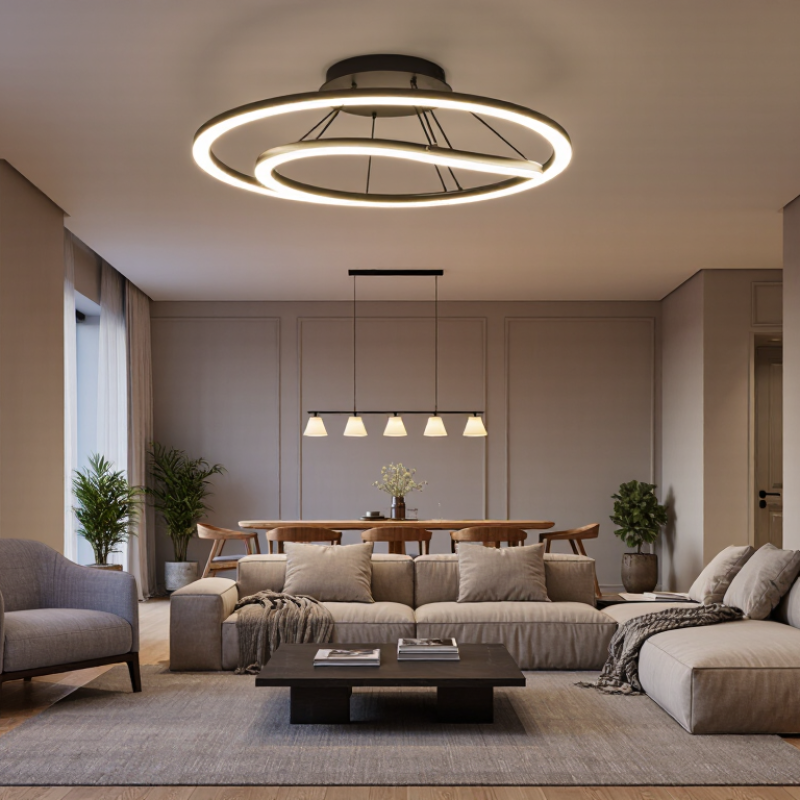
How to Choose Modern Lights for Your Home?

Assess Room Tasks and Lighting Levels Using IES Guidance

Choosing modern lights starts with the work each room needs to support. IES guidance relates recommended light levels to specific tasks, rather than assigning one brightness to an entire home. Reading a recipe, chopping vegetables, and walking through a hallway call for different conditions. Details matter. Check current IES recommendations for the task, then consider where light must land: a desk surface, kitchen counter, or stair tread. A light meter can help assess illuminance at that surface; a phone app is only a rough check.

Use general lighting for safe movement, then add focused fixtures where precision matters. In a kitchen, a ceiling fixture may brighten the room while under-cabinet lights reduce shadows on the counter. At a desk, position a task light to illuminate paper without reflecting into a screen. I have found that a room can feel bright yet leave the actual work area dim. Not always. Glare, dark finishes, fixture height, and daylight all affect the result. IES figures are useful guidance, not a guarantee for every layout, so adjust the setup and reassess it during ordinary use. A small change in angle can make more difference than a stronger bulb.

Compare Lumens, Color Temperature, and ENERGY STAR’s CRI 80 Benchmark

Lumens tell you how much light a bulb produces; watts tell you how much energy it uses. For a reading corner, compare lumen output rather than choosing by wattage alone. A label around 800 lumens often replaces an old 60-watt incandescent bulb, though room size and fixture shade can change how bright it feels. Small details matter.

Color temperature, measured in kelvins, affects the room’s mood. Around 2700K gives a warm, amber-like glow for bedrooms and living rooms. A range near 3000K to 4000K can feel clearer in kitchens or work areas. Higher numbers tend to look cooler, not necessarily brighter. I still find that a bulb’s color can look different at night than it did in the store, so check it in the actual room before buying several.

CRI describes how naturally a light reveals colors. ENERGY STAR’s CRI 80 benchmark is a useful minimum when comparing qualifying lighting products. At that level, colors should appear reasonably true, though reds or skin tones may still look less vivid than under higher-CRI light. Check the package for both CRI and color temperature; neither number tells the whole story. A favorite paint color can look surprisingly flat under the wrong bulb.

How to Choose Modern Lights for Your Home

Compare lumens, color temperature, and ENERGY STAR’s CRI 80 benchmark.

Lumens measure light output; these approximate levels correspond to familiar incandescent bulb equivalents. Choose color temperature by mood: warm white is about 2700–3000 K, neutral white about 3500–4100 K, and daylight about 5000–6500 K. For color rendering, look for a CRI of at least 80, the ENERGY STAR benchmark for qualified light bulbs.

Choose LED Fixtures: DOE Reports 75% Less Energy Use Than Incandescent

When choosing modern lights, start with the room’s purpose, not just the fixture’s shape. A kitchen counter needs clear, even light; a bedside lamp often works better with a softer glow. Small details matter. The U.S. Department of Energy reports that LED lighting uses at least 75% less energy than incandescent lighting. In rooms where lights stay on for hours, that difference can help lower electricity use.

Compare lumens, not watts, when checking brightness. A focused fixture may suit a reading corner better than one bright ceiling light. Warm light can feel relaxing in a bedroom, while a neutral tone may help with detailed work. Check the label. Some LEDs are compatible with dimmers, but not all; a mismatch can cause flickering or buzzing. This is easy to overlook.

Measure ceiling height and notice where shadows fall at dusk. A sleek pendant can look right online yet hang too low above a table. Looks can mislead. Actual savings depend on usage, fixture design, and the LED selected. The 75% figure is a comparison, not a guarantee for every home.

How to Choose Modern Lights for Your Home? — Choose LED Fixtures: DOE Reports 75% Less Energy Use Than Incandescent

Compare lights by brightness (lumens), not just wattage. The examples below show typical LED wattages for similar light output; actual products vary.

Typical Use Target Brightness Incandescent Equivalent Typical LED Power Estimated Energy Reduction Annual Use at 3 Hours/Day
Accent or small bedside light About 450 lumens 40 W About 5 W About 88% Incandescent: 43.8 kWh
LED: 5.5 kWh
Bedroom or hallway light About 800 lumens 60 W About 9 W About 85% Incandescent: 65.7 kWh
LED: 9.9 kWh
Kitchen or general room lighting About 1,100 lumens 75 W About 12 W About 84% Incandescent: 82.1 kWh
LED: 13.1 kWh
Bright room or larger area About 1,600 lumens 100 W About 17 W About 83% Incandescent: 109.5 kWh
LED: 18.6 kWh

Energy-use estimates assume 3 hours of operation per day for 365 days and are calculated from the listed wattages. The U.S. Department of Energy reports that LED bulbs use at least 75% less energy than incandescent lighting; actual savings depend on the specific products and usage.

Estimate Lifespan: DOE LEDs Can Last Up to 25 Times Longer

When choosing modern lights, look beyond the shape of the shade. An LED’s rated lifespan can affect replacement costs, maintenance, and how often you climb a ladder. The U.S. Department of Energy notes that LED bulbs can last up to 25 times longer than incandescent bulbs. That comparison is an upper limit, not a promise for every bulb or household.

Check the rated hours on the package, then consider where the light will go. A ceiling fixture in a warm, enclosed hallway may put more stress on a bulb than an open table lamp. Frequent switching, incompatible dimmers, and trapped heat can also affect performance. A quick check helps. Many LED ratings describe how long a bulb takes to fall to about 70 percent of its original brightness, rather than the moment it stops working. That detail is easy to miss.

I’d match the rating to the room’s real use, not just the biggest number on the label. A hard-to-reach stairwell may benefit from a longer-rated bulb; a decorative light used briefly each evening may not need one. Lifespan estimates still involve assumptions, and real homes are messy. Dust, heat, and habits vary. A little uncertainty belongs in the decision.

Check Dimming, Smart Controls, and UL or ETL Safety Listings

A well-chosen modern light should feel comfortable at full brightness and at its lowest useful setting. Check the fixture’s specifications before buying a dimmer. Some LEDs flicker, buzz, or drop out when paired with incompatible controls. Confirm that the bulb and dimmer are designed to work together, and check the dimmer’s minimum load. A warm glow over a reading chair may suit evenings better than harsh, full-power light. Small details matter.

Smart controls can add convenience, but compatibility still matters. Check whether the fixture works with your preferred control system and whether it needs a hub or a steady wireless connection. Try the controls where you will use them: beside the bed, near the entry, or through a wall switch. A scheduled fade can be pleasant. A complicated app may not be. It is easy to overestimate how often you will use every feature.

Look for a UL or ETL safety listing on the product or its documentation, and verify that the listing applies to the exact fixture, not just an included accessory. These marks indicate evaluation to applicable safety standards; they do not guarantee that a light suits every installation. Check the voltage, location rating, and installation instructions, especially for damp rooms or enclosed fixtures. Read the label carefully. I would not skip this step just because the light looks well made.