How to Choose a Coil Transfer Cart in 2026?
Choosing a Coil Transfer Cart in 2026 is a practical engineering decision, not a catalog exercise. The right cart must match the coil’s weight, diameter, width, and center of gravity. It must also fit the route between the slitter, storage area, and production line. A mismatch can mean awkward loading, blocked aisles, or unnecessary strain on equipment.
For a clear selection principle, this guide uses a fictional composite specialist, Jordan Lee: “Choose the cart for the heaviest coil and tightest turn you actually handle.” This is an illustrative quote, not a verified statement from a real industry expert. The point is concrete: check the heaviest load, measure the narrowest aisle, and test turning clearance before comparing drive systems or custom features.
Small details matter. A recessed coil cradle, for example, can help limit movement during transport. But it should suit the coil’s dimensions and the loading method. Power options, floor condition, travel distance, controls, and maintenance access deserve equal attention. A cart that performs well on a smooth test floor may behave differently near joints, ramps, or busy workstations.
The sections ahead explain how to define capacity, assess safety features, compare manual and powered designs, and review supplier support. No specification replaces a site check. That step is easy to postpone. It is also where a buyer may catch a poor fit before it becomes an expensive one.
Define the Coil-Handling Task and Operating Environment
How to Choose a Coil Transfer Cart in 2026?
Define the Coil-Handling Task and Operating Environment
Start by defining the coils the cart will carry. Record their maximum weight, outside diameter, width, and core orientation. Include the loading and unloading method, travel distance, and expected trips per shift. Small details matter. A coil moved horizontally may need different support from one carried vertically.
Map the full route, not just the straight aisle. Measure doorways, turning spaces, floor joints, and clearances beneath equipment. Check the floor for slopes, oil, dust, or uneven patches. Watch the transitions. A cart that performs well on smooth concrete may behave differently near a ramp or expansion joint. Numbers are not enough; observe the route during a typical shift, when people and other equipment are present.
Then match the cart’s capacity and support design to the real task, with a sensible margin based on the load and operating conditions. Specify how coils are restrained, and confirm that operators can load them without awkward reaches. A tidy drawing can still miss a tight turn or a floor seam. This is where plans often need revision. Walk the route with the proposed dimensions before finalizing the selection.
Compare Cart Types, Load Capacities, and Power Options
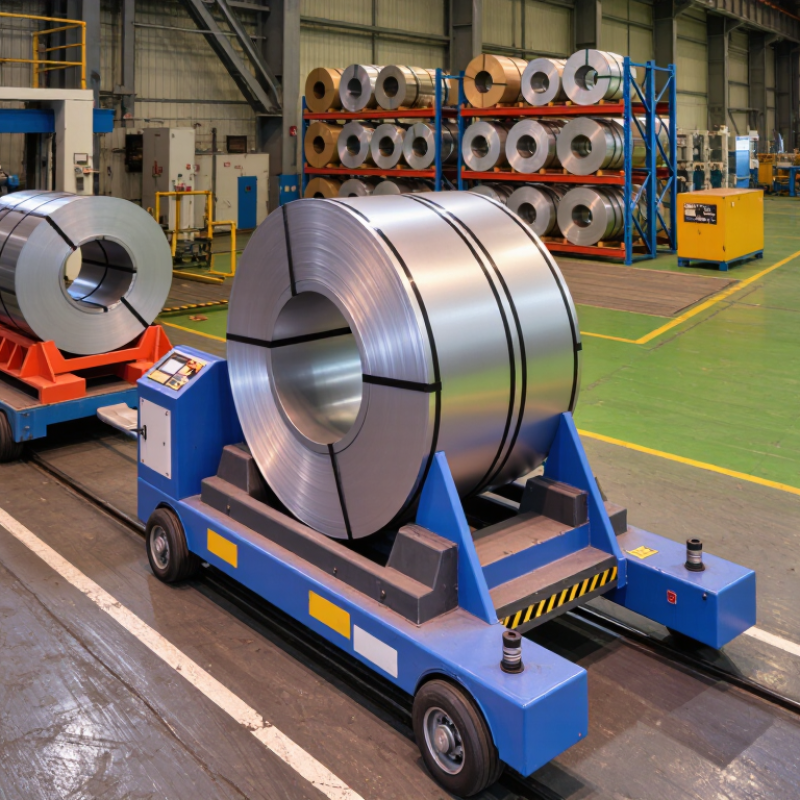
A coil transfer cart should match the coil, route, and loading method—not just the headline capacity. A V-cradle helps keep a coil centered, while a flat deck with a removable saddle offers more flexibility for mixed loads. Measure coil width, diameter, and core orientation. Then check how the crane or forklift places it. Small details matter.
Capacity needs a careful margin. Use the heaviest expected coil, not the daily average, and account for the cradle and any fixtures. A cart rated too close to the working load may leave little room for uneven placement or starting forces. More capacity is not always better; an oversized cart can be harder to maneuver in tight aisles.
Power choice depends on the route. Battery carts suit changing paths and avoid trailing cables, but charging time and battery performance in cold areas need planning. Cable-reel systems work well on defined routes, though cable handling can become a nuisance near crossings. Rail-fed options fit long, fixed tracks. Check travel distance, shift length, floor condition, braking, and stop accuracy. Test with a real coil when possible. Specifications can look tidy; actual handling sometimes does not.
Assess Coil Cradles, Safety Systems, and Controls
How to Choose a Coil Transfer Cart in 2026?
Assess Coil Cradles, Safety Systems, and Controls
A coil cradle should match the coil’s width, diameter, weight, and eye orientation. Check the saddle contact points: a poor fit can let a coil shift during travel. Confirm the cart’s rated capacity includes the load and any fixtures.
Safety deserves equal attention. The U.S. Bureau of Labor Statistics reported 2.8 recordable injury and illness cases per 100 full-time workers in manufacturing in 2023. That figure is not specific to coil handling, but it reinforces the value of risk controls. Look for clear load limits, effective brakes, emergency stops, and suitable warning or obstacle-detection systems. Sensors help, but they cannot replace a clear travel path.
Controls should suit the route and the operator’s view. A pendant or radio control can improve positioning, while speed limits and interlocks can reduce unsafe movement. Test stop functions and inspect cables, wheels, and cradle wear on a regular schedule. One detail is easy to overlook: the coil may block the operator’s sightline. Walk the route before choosing a control layout. Small detail.
Tips: Ask suppliers to explain how the cradle fits your actual coil range. Test the cart with a representative load, including turns and stopping points. Keep the trial practical; a smooth floor test may not reveal problems on your real route.
Check Route Compatibility and Production-Line Integration
A coil transfer cart should be selected for the route it will actually travel, not only its rated capacity. Measure aisle width, turning radius, floor joints, slopes, and overhead clearance with the heaviest coil loaded. Small details matter. A tight turn can shift the load, while a floor seam may affect wheel contact and stopping accuracy. Check crossings, pedestrian zones, and waiting points during a normal production shift; an empty-floor inspection can miss traffic conflicts.
Production-line integration matters just as much. Match the cart’s stopping positions to the coil pickup and handoff points, including conveyor height and operator access. Confirm how the cart receives commands from line controls, and test sensors, emergency stops, and handshakes before routine use. Allow for battery charging or power connections without blocking the aisle. I would not treat a clean CAD route as proof of compatibility. Run loaded trials at realistic speeds, record stopping variation, and repeat them at busy shift times. One imperfect trial is useful; it often reveals a clearance or timing issue that drawings missed. Repair plans and operator feedback should shape the final route.
