Industries
Get direct access to our extensive portfolio of optical products and specialist technical expertise.
Rccb Meaning refers to Residual Current Circuit Breaker: a device that disconnects power when it detects current leaking from its intended path. In a home, that protection can matter near a bathroom outlet, kitchen appliance, or outdoor socket. An RCCB can reduce the risk of electric shock and help limit some electrical hazards. It does not usually protect against overloads or short circuits by itself. That distinction matters. A suitable installation may also need separate overcurrent protection.
Choosing a type in 2026 depends on the equipment connected and the leakage-current waveforms it may produce. Type AC detects sinusoidal alternating residual current. Type A also responds to pulsating direct current, which can occur with some electronic appliances. Types F and B support additional current characteristics and may suit certain variable-speed equipment, heat pumps, or EV charging setups. Check the appliance and charger manufacturer’s instructions. A higher-numbered type is not automatically the better choice.
There is no universal winner. The right RCCB depends on the circuit, expected loads, sensitivity requirements, and local electrical rules. A qualified electrician can assess these details, select compatible protection, and verify the device after installation. Product labels and test buttons are useful, but they cannot confirm every aspect of a circuit. Even this overview has limits: equipment designs change, and product descriptions are not always clear. The guide ahead explains key RCCB types, where they may fit, and what to check before choosing one.
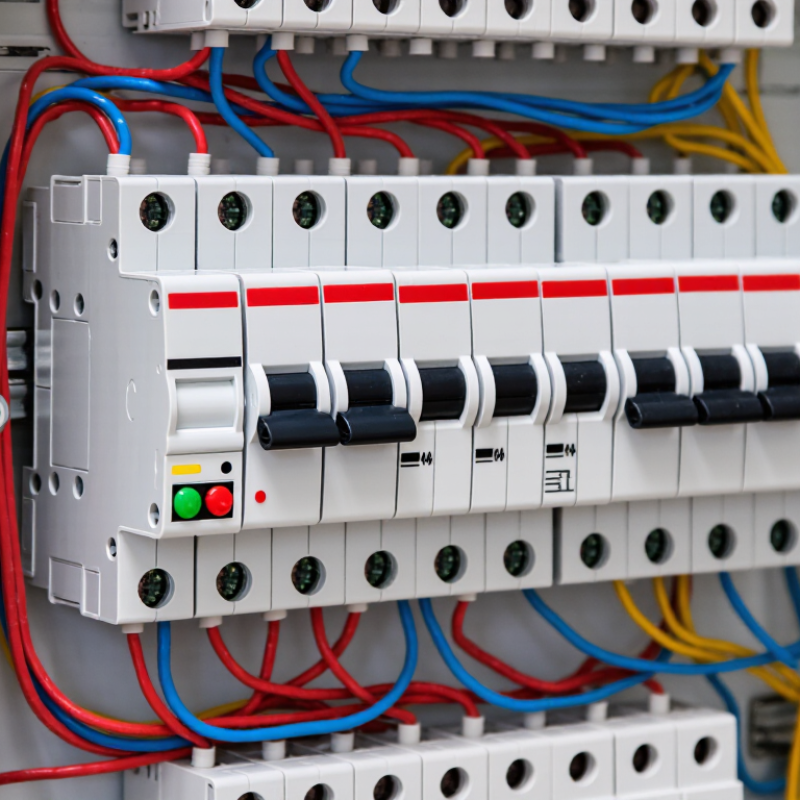
RCCB means Residual Current Circuit Breaker. It monitors the current flowing through live and neutral conductors. Under normal conditions, those readings match. If current escapes through a person, damaged insulation, or a damp wall, the difference can trigger a rapid disconnection. That is the key protection it provides: detecting earth-leakage current, not every electrical fault. An RCCB alone does not provide overload or short-circuit protection; a suitably rated circuit breaker is also needed. An RCBO combines these functions.
The distinction matters. NFPA’s 2021 report on U.S. home structure fires estimated 24,000 fires annually involving electrical distribution or lighting equipment during 2015–2019. An RCCB may help reduce some shock and leakage-related risks, but it cannot prevent every electrical fire. It also does not identify the faulty appliance or cable. A trip is a clue, not a diagnosis. Check the circuit carefully; repeated tripping needs qualified attention.
Tip: Test the RCCB using its test button at the interval stated by its manufacturer, and have a qualified electrician investigate abnormal results. IEC 61008-1 covers RCCBs without integrated overcurrent protection, while IEC 61009-1 covers RCBOs. Labels can be confusing, so confirm the device type and the protection provided for each circuit.
An RCCB, or residual current circuit breaker, watches the current flowing through live and neutral conductors. In normal operation, their currents balance. If some current escapes through a damaged cable, wet appliance, or person touching a live part, the balance changes. The RCCB detects this residual current and opens its contacts, cutting power to that circuit. The trip can reduce the duration of an electric shock, but it cannot make contact with live electricity safe.
Imagine a hair dryer beside a damp bathroom sink. If a fault sends current through an unintended path, an appropriately selected RCCB may trip before the hazard continues. That difference matters. It does not usually protect against overloads or short circuits, so circuit protection may also be needed. A combined RCBO provides residual-current and overcurrent protection in one device.
Which type is best in 2026 depends on the equipment and installation, not just the date. Type A suits many circuits with modern electronic appliances; other loads may call for Type F or Type B. Check the appliance instructions and have a qualified electrician assess the circuit and local requirements. A rating printed on the device is not the whole answer. Selection can be less obvious than it looks. Test the RCCB using its test button at the interval stated by its manufacturer, and investigate repeated trips rather than repeatedly resetting it.
| Topic | Typical Details | Practical Guidance |
|---|---|---|
| Meaning of RCCB | Residual Current Circuit Breaker. It detects an imbalance between the current flowing through the live conductor(s) and the current returning through the neutral conductor. | An RCCB is designed to disconnect a circuit when residual current is detected. It does not, by itself, provide overload or short-circuit protection. |
| How it trips | In normal operation, outgoing and returning currents balance. If some current leaks to earth—potentially through a person—the imbalance operates the sensing mechanism and opens the contacts. | Tripping can reduce the duration of electric shock exposure, but an RCCB does not make contact with live parts safe or prevent every shock. |
| Overcurrent protection | A separate fuse or circuit breaker is normally required for overload and short-circuit protection. An RCBO combines residual-current and overcurrent protection in one device. | Check that the installation has the required overcurrent protection and that the RCCB is coordinated with it. |
| Type AC | Designed to detect sinusoidal alternating residual current. | Use only where permitted by local rules and where the connected loads are known to produce compatible residual-current waveforms. It may not be suitable for equipment that can produce pulsating DC or other waveform components. |
| Type A | Detects sinusoidal AC and pulsating DC residual current. | A common choice for many general-purpose circuits with electronic loads, but it is not suitable for every appliance or installation. |
| Type F | Designed for specified mixed-frequency residual currents, including certain single-phase variable-speed equipment; it also covers Type A detection characteristics. | Consider it where equipment instructions or the circuit design call for protection suited to single-phase frequency-controlled loads. |
| Type B | Designed to detect AC, pulsating DC, and smooth DC residual currents within the device’s specified operating range. | May be required for some three-phase drives, inverters, EV charging arrangements, or other equipment capable of producing smooth DC residual current. Follow equipment instructions and local standards. |
| 30 mA residual-current rating | A common sensitivity for additional protection against electric shock in many applications. The exact requirement depends on local electrical rules and the circuit. | Do not treat 30 mA as a guarantee against injury. Correct installation, earthing, equipment condition, and timely testing remain essential. |
| Higher ratings, such as 100 mA or 300 mA | May be used for particular fire-protection or upstream coordination purposes, depending on the installation and applicable rules. | These ratings are not a general substitute for 30 mA additional protection where that protection is required. |
| Which type is best in 2026? | There is no universally best type. The appropriate choice depends on the load’s possible residual-current waveform, device instructions, installation design, and local regulations. | Type A is often a practical starting point for ordinary modern circuits; choose Type F or Type B when the connected equipment or applicable rules require their additional detection capability. Have a qualified electrician verify the selection. |
| Testing and maintenance | Many RCCBs include a test button that checks the device’s operating mechanism under the conditions specified by its manufacturer. | Test at the interval stated by the manufacturer and local rules. A test-button check does not replace professional inspection or instrument testing. |
Safety note: RCCB selection, installation, and testing should follow the applicable electrical code and the connected equipment manufacturer’s instructions. Consult a qualified electrician; never rely on an RCCB as the sole safeguard against electric shock.
An RCCB compares the current flowing through live and neutral conductors. If some current leaks to earth, it disconnects the circuit. Its type describes which residual-current waveforms it can detect. That distinction matters.
Type AC detects sinusoidal alternating residual current. It may suit simple circuits with resistive loads, such as a basic heater.
Type A also detects pulsating direct current, which can occur in equipment with electronic controls, including washing machines and power supplies.
Type F covers these waveforms and certain mixed-frequency currents from single-phase variable-speed equipment.
Type B provides broader coverage, including smooth direct current and specified higher-frequency residual currents. It may be needed for some electric vehicle charging or inverter systems, depending on their design.
There is no single best type for every installation. Check the appliance instructions and the RCCB’s technical data, especially its stated frequency range and rated residual operating current. A label alone can be misleading. An RCCB also does not generally provide overload or short-circuit protection, so suitable overcurrent protection is needed. When equipment details are unclear, have a qualified electrician assess the circuit. The choice deserves a second look.
RCCB means residual current circuit breaker. It disconnects power when current leaks from its intended path, helping reduce electric-shock and fire risks. It does not protect against overloads or short circuits, so it normally works alongside an overcurrent protective device. The right type depends on the equipment connected.
Type AC responds to sinusoidal AC leakage. It may suit simple circuits with steady resistive loads, such as basic lighting, where equipment requirements allow it. Type A also detects pulsating DC leakage, which can occur with electronic controls in appliances and dimmers. Look beyond the room label. A kitchen circuit may contain several different loads.
Type F handles Type A waveforms and certain mixed-frequency residual currents. It is often considered for single-phase variable-speed equipment, such as some inverter-driven appliances. Type B covers a broader range, including smooth DC leakage, and may be required for particular charging or inverter systems. Check the equipment instructions. There is no universal winner.
In a real panel, choosing by the appliance’s name alone can miss its internal electronics. I would verify the required RCCB type against the equipment documentation and have a qualified electrician check the installation.
What Does RCCB Mean and Which Type Is Best in 2026?
How to Choose the Best RCCB for an Installation in 2026
An RCCB, or residual current circuit breaker, disconnects supply when current leaks from its intended path. It does not protect against overloads or short circuits. Pair it with suitable overcurrent protection. A small detail, but essential.
Choose the RCCB by checking the installation’s load, earthing arrangement, pole count, rated current, and required residual operating current. For many residential circuits, 30 mA protection is used for additional shock protection, subject to local electrical rules. Type AC detects sinusoidal alternating residual current; Type A also detects pulsating direct current. Equipment with variable-speed drives or electronic controls may need Type F or Type B, depending on the manufacturer’s instructions and fault-current characteristics. IEC 61008-1 and IEC 62423 describe relevant RCCB requirements and types.
Use the connected equipment as your guide, not just the panel label. A heat pump, induction hob, or EV charging point can produce different residual-current waveforms. In a 2023 NFPA report, U.S. home electrical fires averaged an estimated 46,700 incidents annually from 2015–2019, causing 390 civilian deaths and $1.5 billion in direct property damage. RCCBs cannot prevent every electrical fire, but correct selection and testing matter. Check device compatibility, upstream protection, and trip-test results with a qualified electrician. A tidy diagram helps. It is not enough.