What Are the Types of Optical Fiber?

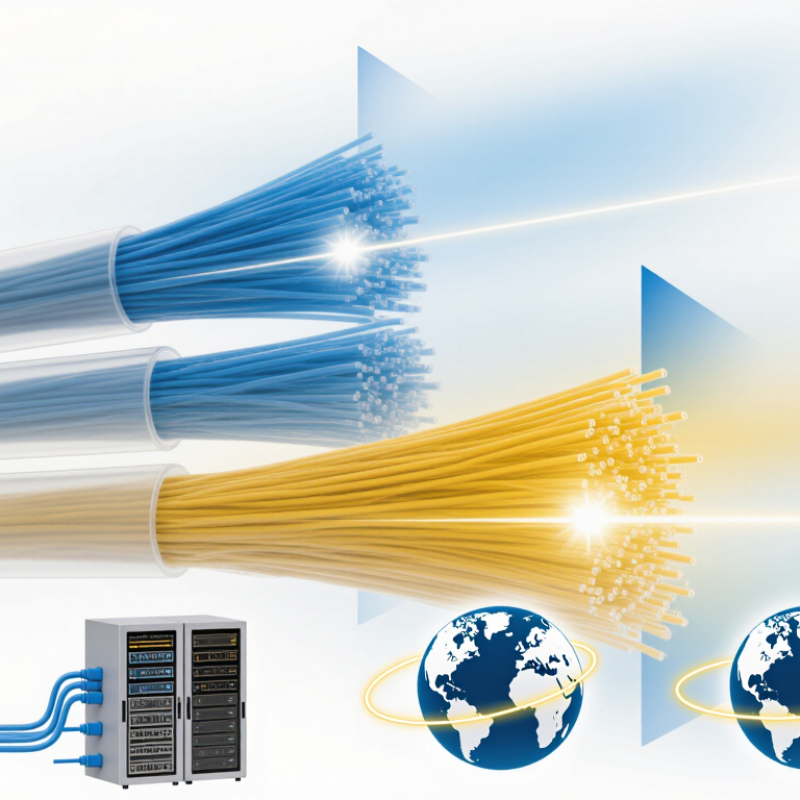
Optical fiber is not a single, uniform technology. It is a family of thin glass or plastic strands that guide light, carrying information across rooms, cities, and oceans. The differences matter. A technician connecting a blue cable in a data center may be handling multimode fiber, while a long-distance network often relies on single-mode fiber. Both use light, but their core sizes, signal paths, and practical strengths differ.

Optical-fiber pioneer Charles K. Kao described the field’s promise with the words, “The potential of optical communication is enormous.” That potential depends on choosing the right fiber for the job. This guide introduces the main types, including single-mode and multimode fiber, and explains how construction and material choices affect performance. It also distinguishes common labels such as OS2 and OM4, which can make product specifications feel more confusing than they need to be.

The categories are useful, but not perfect. A fiber’s label alone cannot tell you whether it suits a particular distance, connector, or operating environment. Small details matter: the installed cable, the optics at each end, and even a tight bend near a rack can affect a link. This overview offers a practical starting point, not a substitute for checking equipment specifications. Some distinctions remain easy to blur. That is worth remembering.
What Are the Types of Optical Fiber?

How Optical Fibers Are Classified

What Are the Types of Optical Fiber?

How Optical Fibers Are Classified

Optical fibers are classified in several ways, and the categories can overlap. A common distinction is how many light paths the core supports. Single-mode fiber has a very narrow core and carries one main light path. It is often used for long-distance links. Multimode fiber has a wider core, allowing several light paths. It commonly suits shorter connections, such as links within a building. The labels can feel confusing at first.

Fibers are also grouped by their refractive-index profile. In step-index fiber, the core’s refractive index changes sharply at the boundary with the cladding. In graded-index fiber, it changes gradually from the center outward. This gradual profile helps reduce differences in how light paths travel through multimode fiber. Material is another classification: most communication fibers use glass, while plastic optical fiber is used in some shorter-range applications. These categories describe different features, so one fiber can belong to more than one group.

Tips: Check the application, distance, and equipment before choosing a fiber. Look at the core size and index profile in the technical specifications. A label alone may not tell the whole story; I would verify compatibility rather than assume two fibers are interchangeable.

Single-Mode Optical Fiber: Structure and Signal Transmission

Single-mode fiber has a tiny glass core, typically about 9 micrometers across, surrounded by 125-micrometer cladding. The cladding has a slightly lower refractive index, guiding light along the core. At the right wavelength, only the fundamental light mode travels through it. One path. Less modal dispersion over long distances.

The ITU-T G.652 recommendation gives typical maximum attenuation limits of 0.4 dB per kilometer at 1310 nm and 0.3 dB per kilometer at 1550 nm. These figures help explain why operators use single-mode fiber for long-haul links. Its core is so narrow that alignment and connector cleanliness matter; a speck of dust can disrupt a connection. That neat diagram can mislead. It leaves out real installation bends, splices, and aging connectors.

For tighter routing, ITU-T G.657 covers bend-insensitive single-mode fiber, with specified performance tests for bending. It does not make sharp bends harmless. Engineers still check bend radius and link loss during installation, rather than trusting the cable label alone. A practical detail: inspect the end face before testing. Small flaws can change the reading.

What Are the Types of Optical Fiber? - Single-Mode Optical Fiber: Structure and Signal Transmission

Dimension Typical Description or Value Role in Structure or Signal Transmission
Fiber category Single-mode optical fiber (SMF) Designed to guide one principal spatial mode at its specified operating wavelengths, helping limit modal dispersion.
Core Typically about 8–10 µm in diameter; the exact design varies. The central glass region guides the optical field. The mode field extends beyond the physical core boundary.
Cladding Commonly 125 µm in glass diameter. Surrounds the core and has a slightly lower refractive index, creating the refractive-index profile that confines the guided mode.
Protective coating Polymer coating, commonly applied in layers; a 250 µm coated diameter is widely used. Protects the glass from moisture, abrasion, and handling damage. It is not the optical cladding.
Common operating windows Around 1310 nm and 1550 nm for many telecommunications fibers. These wavelength regions are widely used because fiber attenuation and dispersion characteristics suit long-distance transmission.
Guided signal Light is launched into the fiber by a suitable optical source and coupling system. The core–cladding refractive-index profile guides the electromagnetic field along the fiber as a mode; transmission is not simply a ray bouncing down the core.
Attenuation For many standard single-mode fibers, maximum values are specified around 0.35 dB/km at 1310 nm and 0.22 dB/km at 1550 nm; actual specifications vary. Lower attenuation means less optical power is lost over distance. Connectors, splices, bends, and the fiber itself contribute to the link loss.
Chromatic dispersion For conventional dispersion-unshifted fiber, dispersion is near zero around 1310 nm and is commonly about 17 ps/(nm·km) near 1550 nm. Different spectral components travel at different speeds, broadening pulses. System design accounts for dispersion over the link distance and data rate.
Common standardized families Examples include ITU-T G.652 conventional single-mode fiber and G.657 bend-insensitive single-mode fiber. The applicable family defines performance characteristics; the choice depends on route length, bending conditions, wavelength, and system requirements.
Typical applications Long-haul and metro networks, data-center links, and access networks. Its low modal dispersion and low loss make it suitable for high-capacity links, with the achievable reach determined by the complete optical system.

Note: Values are representative of common telecommunications single-mode fiber designs. Consult the relevant fiber specification for exact limits.

Multimode Optical Fiber: Step-Index and Graded-Index Designs

Multimode optical fiber carries light through a relatively wide core, allowing several paths, or modes, to travel at once. Its two common designs are step-index and graded-index. The difference lies in how each core guides light. Small details matter.

In step-index fiber, the refractive index changes sharply between the core and its outer layer. Light rays bounce along the core, often taking different distances to reach the receiver. This modal dispersion can limit bandwidth over longer runs. The design is straightforward, but it is not automatically the best choice for every short link.

Graded-index fiber changes the refractive index gradually from the core’s center toward its edge. Rays curve rather than making abrupt reflections, helping them arrive closer together and reducing modal dispersion. A simple diagram can make this look perfectly uniform; real installation conditions still deserve attention.

Tips: Match the fiber type to the link’s distance, required data rate, and compatible transmitters. Check the cable markings before installation. Keep bends broad and connectors clean. A quick visual inspection may miss a poor connection, so verify performance with suitable test equipment.

Optical Fibers Classified by Core Material and Transmission Range

What Are the Types of Optical Fiber?

Optical Fibers Classified by Core Material and Transmission Range

An optical fiber’s core carries light, while its cladding helps keep that light inside. Fibers are commonly grouped by core material: silica glass, plastic, or glass with plastic cladding. The material affects handling, signal loss, and practical reach. It does not determine distance alone.

Silica fiber is widely used for both short and long links. Single-mode fiber has a narrow core, typically around 8–10 micrometers, and supports long-distance transmission with suitable equipment. Multimode fiber has a wider core, often 50 or 62.5 micrometers. It is common in shorter building connections. Plastic optical fiber has a much larger core and is flexible and easy to handle, but generally suits shorter runs because more signal is lost along the way. Plastic-clad silica sits between these options, pairing a glass core with plastic cladding.

Distance depends on more than the fiber category. Data rate, wavelength, connectors, and tight bends all affect performance. A clean connector matters. Even a small bend behind a cabinet can weaken a signal. In practice, choosing by material alone is an incomplete rule; check the equipment specifications and the actual route before selecting a fiber.

FAQS

What is the difference between single-mode and multimode fiber?

Single-mode fiber has a narrow core and carries one main light path. Multimode fiber has a wider core that supports several paths.

How do step-index and graded-index fibers differ?

Step-index fiber has a sharp change in refractive index at the core boundary. Graded-index fiber changes gradually, helping light paths arrive closer together. Small details matter.

What materials are used in optical fiber cores?

Common options include silica glass, plastic, and glass with plastic cladding. Material affects handling and signal loss, but does not decide reach by itself.

Which fiber type is commonly used for long-distance links?

Single-mode silica fiber is often used for long links with suitable equipment. Its core is typically around 8–10 micrometers wide.

When is plastic optical fiber a practical choice?

Plastic optical fiber is flexible and easy to handle. It generally suits shorter runs because it loses more signal along the way.

Does a fiber category alone tell you its maximum distance?

No. Data rate, wavelength, connectors, equipment, and bends also affect performance. A simple label can leave out important details.

What should you check before choosing a fiber?

Check the route, required data rate, equipment compatibility, core size, and index profile. I might be oversimplifying, but the actual route matters.

How can installation affect an optical fiber link?

Keep bends broad and connectors clean. Even a small bend behind a cabinet can weaken the signal, and a visual check may miss a poor connection.