Industries
Get direct access to our extensive portfolio of optical products and specialist technical expertise.

In 2026, transceiver cable selection is becoming a practical engineering decision, not a simple product comparison. Data centers now balance bandwidth, reach, power, temperature, and installation space.
This introduction examines the leading cable types used with modern QSFP-DD and OSFP transceivers. Direct attach copper cables remain attractive for short server-to-switch links. They offer low latency and usually lower costs. However, thick copper assemblies can restrict airflow inside dense racks. Active optical cables provide longer reach with lighter cabling. They can simplify high-speed connections across adjacent cabinets. Their optical electronics also require careful compatibility checks.
Breakout cables deserve close attention. A single 400G port may connect to four 100G endpoints. This design can support gradual network upgrades, although port mapping becomes easier to misunderstand. Multimode and single-mode fiber assemblies remain important for longer distances. Connector type, wavelength, insertion loss, and polarity all affect real performance. Labels alone are not enough.
This guide compares these options through deployment experience, manufacturer specifications, and recognized Ethernet practices. It also considers 200G, 400G, and emerging 800G environments. Some “top” rankings are subjective. A cable that performs well in a controlled laboratory may behave differently in a crowded rack. That limitation matters. Readers should verify firmware support, transceiver coding, bend radius, and thermal conditions before purchasing. The best choice is rarely the fastest cable alone. It is the cable that delivers stable performance, manageable installation, and predictable lifecycle costs.
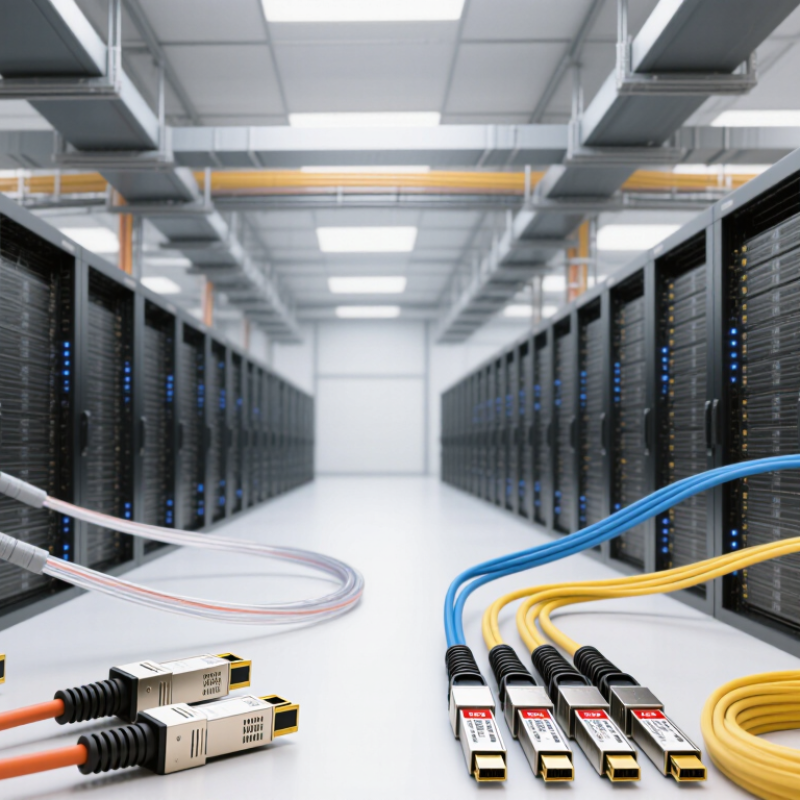
Transceiver cables connect network devices through electrical or optical signals. A switch sends data through a transceiver, then the cable carries it to another switch, server, or storage system. Direct-attach copper cables, or DACs, use short copper assemblies with fixed transceiver ends. They suit server racks because they are affordable and introduce very low latency. Active electrical cables, or AECs, add signal conditioning for longer copper connections. They cost more, but they can simplify high-speed links.
Optical cables use light instead. Active optical cables, or AOCs, combine transceivers and fiber inside one assembly. They are practical for moderate rack-to-rack distances. Separate optical transceivers with duplex or parallel fiber provide greater flexibility. Single-mode fiber supports longer distances, while multimode fiber often serves shorter data-center paths. The Ethernet Alliance 2024 Ethernet Roadmap identifies 800GbE and 1.6TbE as important development targets. That direction increases demand for parallel-fiber and high-density optical connections.
LightCounting’s 2025 market outlook links accelerating optical demand to artificial-intelligence clusters and higher switch speeds. The cable is not a minor accessory. Its insertion loss, bend radius, power draw, and connector coding can affect deployment results. I have seen short copper links remain stable, while poorly routed fiber caused intermittent errors. Distance tables are useful, but real installations are messier. Thermal conditions matter too. Choosing by speed alone is still an imperfect habit.
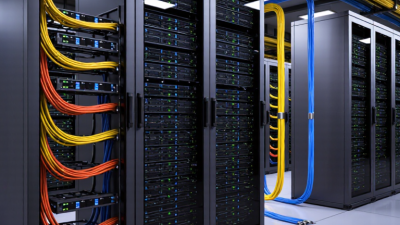
Copper transceiver cables remain practical for short-range data links in 2026. Passive direct-attach copper cables offer low latency, simple installation, and predictable power use. They suit connections between nearby servers, switches, and storage systems. Active copper cables add signal conditioning for longer short-range runs. They cost more, but can preserve link quality across wider rack layouts.
Common options include twinaxial cables, breakout cables, and active electrical cables. A twinaxial design contains paired conductors and shielding. This structure helps reduce interference in dense cabinets. Breakout cables connect one high-speed port to several lower-speed ports. I have found them useful during phased upgrades. However, cable length, connector type, airflow, and bend radius still matter. A fast cable can perform poorly when routed tightly beside power lines.
Tips: Check the equipment’s supported speed and electrical standard before ordering. Measure the real route, not the distance between cabinet labels. Leave gentle curves near connectors. Keep spare cables labeled and tested. A simple continuity check prevents many installation delays. It is not perfect. Compatibility tables can also contain errors, so verify results with live link tests. Watch temperature readings during heavy traffic. Copper cables usually work well over short distances, but they are not universal solutions. For longer paths, optical options may provide better reach and thermal behavior.
Passive direct-attach copper cables are commonly used for very short switch-to-server links, while active copper cables can extend reach in selected data-center applications. Structured copper cabling supports longer horizontal runs, with Cat6A commonly specified for 10 Gigabit Ethernet up to 100 meters and Cat8 generally limited to 30 meters for higher-frequency links.
Reference basis: IEEE Ethernet specifications and ISO/IEC structured-cabling practices. Actual reach depends on signaling rate, connector type, channel construction, installation quality, and equipment qualification.
What Are the 2026 Top Transceiver Cable Types?
How Fiber-Optic Transceiver Cables Enable High-Speed Connections
Fiber-optic transceiver cables convert electrical signals into light pulses for fast, low-loss data movement. In 2026, active optical cables, parallel single-mode fiber, duplex multimode fiber, and breakout cables will remain important. Each type serves a different distance and port-density requirement. Active optical cables suit short data-center links because integrated electronics reduce signal loss and cable weight. Breakout cables split one high-speed connection into several lower-speed links, helping operators connect mixed-generation equipment.
The 2024 Ethernet Alliance Roadmap identifies 800G and 1.6T Ethernet as major development paths. That shift increases pressure on cable insertion loss, bend radius, connector cleanliness, and thermal performance. A 2023 Annual Internet Report projected 5.3 billion internet users and 29.3 billion connected devices by 2023. More endpoints create heavier traffic between switches, servers, and storage systems. Fiber handles this growth with high bandwidth and strong resistance to electromagnetic interference.
Still, speed alone is a poor buying guide. A cable rated for 800G may perform badly after sharp bends, dusty cleaning, or mismatched transceivers. Field validation should include optical power, bit-error rate, temperature, and real rack routing. One overlooked issue remains polarity. A perfect link can fail because transmit and receive paths are reversed. These details are less exciting, but they decide whether high-speed connections remain stable.
| Cable Type | Typical Interface or Fiber Format | Common Data Rates in 2026 Deployments | Typical Reach | Primary Transmission Medium | Key Advantages | Best-Fit Application |
|---|---|---|---|---|---|---|
| Passive Direct-Attach Copper (DAC) | SFP, SFP28, QSFP28, QSFP56, QSFP-DD, or OSFP electrical assemblies | 10G–800G | Usually up to 3 m; exact reach depends on conductor design, connector type, and host electrical specifications | Twinaxial copper | Lowest initial cost and power consumption; very low latency; simple point-to-point connection | Short links between servers, switches, storage systems, and adjacent racks |
| Active Electrical Cable (AEC/ACC) | High-speed pluggable electrical connectors, commonly used with QSFP-DD or OSFP ecosystems | 200G–800G | Typically about 3–7 m, with the actual limit determined by the cable assembly and signaling rate | Copper conductors with active signal conditioning | Longer copper reach than passive DAC; lower power and cost than many optical alternatives | Top-of-rack to adjacent-rack connections where a passive copper cable is too short |
| Active Optical Cable (AOC) | Fixed transceiver ends with SFP, QSFP, QSFP-DD, or OSFP-style connectivity | 10G–800G | Commonly 3–100 m; some multimode designs support longer distances under specified conditions | Multimode or single-mode optical fiber with integrated optical engines | Lightweight, low electromagnetic interference, factory-terminated, and easy to install | Short- to medium-reach data-center links that do not require field-replaceable transceivers |
| Parallel Multimode Fiber Cable | MPO/MTP-style 8-fiber or 16-fiber assemblies paired with parallel multimode transceivers | 40G–800G | Typically up to 70–150 m at high data rates, depending on fiber grade, lane speed, and optical budget | OM3, OM4, or OM5 multimode fiber | High port density, short reach, and efficient lane parallelism; commonly supports VCSEL-based optics | Intra-data-center links between switches, leaf-spine fabrics, and high-density patching areas |
| Parallel Single-Mode Fiber Cable | MPO/MTP-style 8-fiber, 12-fiber, or 16-fiber assemblies paired with parallel single-mode transceivers | 100G–800G | Commonly 500 m to 2 km, depending on the optical module and link budget | OS2 single-mode fiber | Longer reach than multimode fiber; supports parallel optical lanes without wavelength multiplexing | Data-center interconnects, large campuses, and longer switch-to-switch paths |
| Duplex Single-Mode Transceiver Cable | Duplex LC or duplex CS connector assemblies used with duplex serial transceivers | 10G–400G | Approximately 2 km to 10 km for common duplex data-center and metro variants; longer reaches require purpose-specific optics | OS2 single-mode fiber, generally using two fibers | Flexible routing, established connector ecosystem, and straightforward troubleshooting | Campus networks, data-center interconnects, and links requiring a two-fiber serial architecture |
| Breakout or Harness Fiber Cable | One high-density MPO/MTP connector branching to multiple LC, duplex-LC, or smaller form-factor connectors | 40G–800G | Usually up to 100–500 m for multimode designs or up to several kilometers for single-mode designs, subject to the connected optics | Multimode or single-mode fiber | Maps one parallel high-speed port to multiple lower-speed ports; simplifies migration between generations | Leaf-spine architectures, equipment migration, and mixed-speed switch environments |
| Wavelength-Division-Multiplexed Fiber Cable | Duplex LC, duplex CS, or high-density single-mode connectors paired with CWDM or LAN-WDM transceivers | 100G–800G | Commonly 2–10 km for data-center and metro variants; the supported distance depends on wavelength plan and optical budget | Single-mode fiber carrying multiple wavelengths | Uses fewer fibers than parallel optics while supporting longer reach and high aggregate capacity | Inter-building links, metro data-center connections, and fiber-constrained routes |
| Coherent Optical Transceiver Cable Assembly | Duplex single-mode fiber with coherent pluggable modules and standards-based host interfaces | 100G–800G | Typically tens to hundreds of kilometers in qualified transport designs; distance varies substantially with modulation, line system, and optical reach class | Single-mode fiber with coherent modulation and digital signal processing | Very high capacity over long distances; efficient use of fiber pairs; supports metro and regional transport | Data-center interconnect, metro transport, and regional network backbones |
Passive direct-attach copper cables remain practical for short network links. They usually suit rack-to-rack connections within about seven meters. Their low power use and simple design help reduce installation cost. However, thicker copper can restrict airflow around crowded switches. That detail is easy to overlook.
Active copper cables extend reach beyond standard passive limits. They include signal-conditioning components inside the cable assembly. They can support medium-distance links while preserving familiar copper connections. Active optical cables fit longer paths, often from ten to thirty meters or more. They use optical transmission and usually weigh less than copper. For inter-rack routes, that difference matters.
Tips: Measure the real cable path, not the room distance. Check the required data rate, connector type, bend radius, and port compatibility. Leave gentle slack near each connection. Avoid sharp bends behind panels. In practice, a distance chart helps, but it cannot replace testing. Temperature, cable routing, and dense airflow can affect performance. I would also confirm the cable’s rated length before ordering. A slightly cheaper option may create troubleshooting work later. For uncertain links, test one cable under expected load first. That small step can expose compatibility problems before a full installation.
In 2026, cable choice depends on speed, reach, and host compatibility. Direct-attach copper cables suit short 100G, 200G, and 400G links. They usually reach three to five meters. Active optical cables extend practical reach toward 30 meters. They also reduce copper weight inside dense racks.
For longer links, optical transceivers need closer comparison. 400G SR4 commonly supports about 100 meters over multimode fiber. 400G DR4 reaches about 500 meters over single-mode fiber. FR4 can approach two kilometers, while LR4 targets ten kilometers. The Ethernet Alliance’s 2024 roadmap identifies 800G and 1.6T as major development steps. LightCounting’s 2025 optical transceiver forecast also connects AI infrastructure growth with faster optical demand. These figures describe standards, not guaranteed installation results. Heat, fiber quality, and port configuration still matter.
Tips: Check the switch port’s lane rate, FEC setting, connector type, and coding support before ordering. Confirm polarity and fiber mode at both ends. A cable can fit physically yet fail electrically. I have seen this during rack upgrades. A neat spreadsheet still misses airflow and bend radius. That is an imperfect but useful lesson. For 800G links, compare four-lane and eight-lane designs carefully. Their breakout options differ. Record the required distance, insertion loss, and operating temperature. Then test one link before buying hundreds.